
Halspan Achieves EPD Certification for its Prima, Prima Plus, Optima, Halspan, Veria, and Veria Plus Door Cores
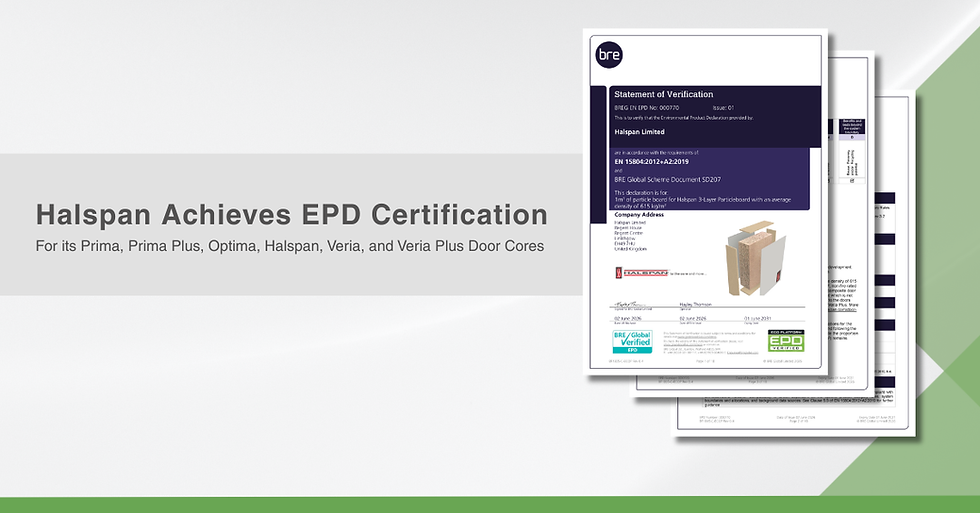
Halspan has strengthened its commitment to transparency and sustainability with the announcement that its 3-layer particleboard door cores - Prima, Prima Plus, Optima, Halspan, Veria, and Veria Plus - have been awarded an Environmental Product Declaration (EPD). This achievement provides the construction industry with robust, standardised environmental data at a time when embodied carbon reporting and responsible material selection are becoming central to building design and procurement.
An EPD is a third‑party verified document that reports a product’s environmental impact across its entire life cycle, from raw material extraction through manufacturing, use, and end‑of‑life. Based on Life Cycle Assessment (LCA) methodology and governed by international standards such as ISO 14025 and ISO 14040/14044, an EPD offers transparent, comparable data without marketing claims or subjective interpretation. It enables architects, specifiers, and fabricators to evaluate materials using consistent, science‑based metrics.
Dave Hallam, Testing & Certification Process Manager at Halspan, said:
"Achieving EPD certification for our Prima, Prima Plus, Optima, Halspan, Veria and Veria Plus door cores marks an important milestone in our commitment to transparency and sustainability.
"By providing independently verified environmental data, we're helping customers make more informed decisions while supporting the industry's transition towards more responsible, data-driven material selection.
"It's another step forward in helping to build a more sustainable future—through greater transparency, trusted data, and informed product choices."
Demand for EPDs has accelerated significantly as the construction sector works to reduce embodied carbon and meet evolving regulatory requirements. In the UK, Europe, and global markets, planning authorities, public procurement frameworks, and private clients increasingly require verified environmental data as part of project submissions.
The newly issued EPD for Halspan’s Prima, Prima Plus, Optima, Halspan, Veria, and Veria Plus door cores provide the industry with a consistent dataset that can be integrated into whole‑building LCAs, embodied carbon calculations, and sustainability‑driven specification decisions. For architects and specifiers, this means Halspan products can be compared with products covered by EPDs prepared to the same Product Category Rules (PCRs), supporting embodied carbon assessments aligned with RIBA 2030 Climate Challenge targets and LETI guidance. For fabricators, the availability of the EPD strengthens their ability to meet tender requirements, respond to client sustainability expectations, and demonstrate alignment with low‑carbon construction goals.
The benefits extend across the supply chain. Contractors and developers can incorporate Halspan’s EPD into project‑wide carbon reporting, improving transparency and reducing risk. End clients gain assurance that the materials used in their buildings are supported by independently verified environmental information, contributing to credible sustainability claims and long‑term asset value.
By securing the EPD for Prima, Prima Plus, Optima, Halspan, Veria, and Veria Plus door cores, Halspan reinforces its position as a trusted partner in the transition to more sustainable construction. The declarations provide a clear, standardised foundation for environmental comparison and demonstrate Halspan’s proactive role in supporting the industry’s shift toward responsible, data‑driven material selection.
To discuss how these EPDs can support your project, or to request technical guidance, contact Halspan’s technical team.
Read Halspan's EPD in full at greenbooklive.co.uk.


